
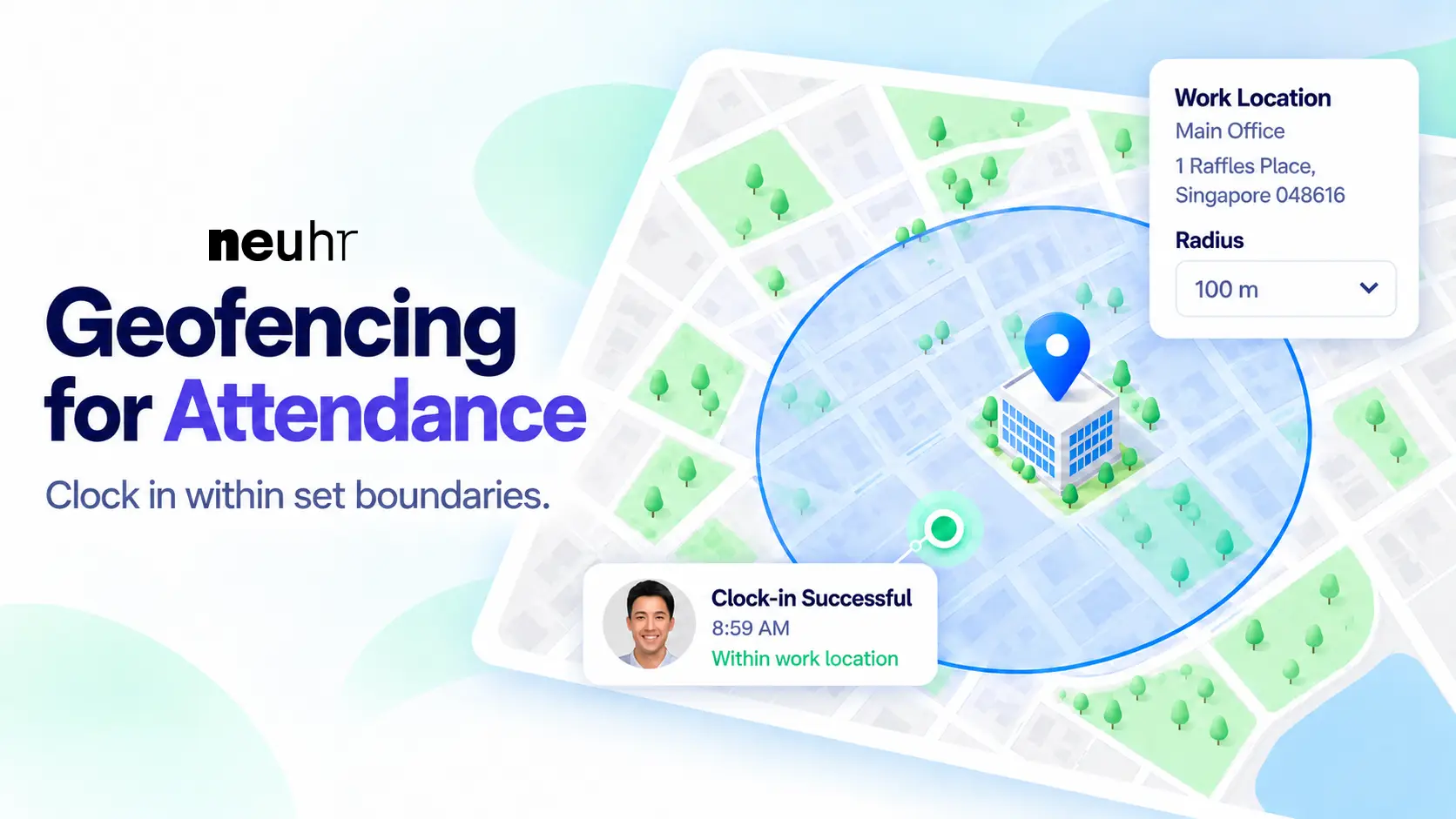
Managing attendance is simple when everyone works from the same place. But for businesses with multiple outlets, offices or client sites, HR may also need to know whether an attendance record was made from an approved workplace.
Geofencing attendance adds location-based rules to the employee attendance management process. It can help HR teams manage where attendance is recorded, while still allowing for legitimate exceptions.
Key takeaways
- Geofencing creates a virtual boundary around an approved workplace and checks an employee’s reported location when attendance is recorded.
- Different attendance systems handle geofencing differently. They may record a location, flag an exception for review or restrict attendance outside an approved area.
- Geofencing can support flexible and multi-location work arrangements, including retail outlets, different offices, client sites and approved work-from-home locations.
- Geofencing checks the device’s reported location not employee identity or productivity, so HR still needs clear processes for exceptions and attendance reviews.
- Singapore employers using employee location data should consider their PDPA obligations and clearly communicate how location information is collected and used.
Table of contents
- What is geofencing?
- How does geofencing work for employee attendance?
- What are the benefits of geofencing attendance?
- What should HR consider before using geofencing?
- Is geofencing suitable for every workplace?
- See how NeuHR approaches geofencing attendance
- Frequently asked questions
What is geofencing?
Geofencing is a technology that creates a virtual boundary around a real-world location. In attendance management, geofencing allows a system to check whether an employee is within an approved workplace when they clock in or out.
Think of it as drawing an invisible perimeter around a workplace, such as an office, retail outlet or approved client site. When an employee records attendance, the system checks the location reported by their device against that approved area.
Depending on the software, the system may record the location, flag an attendance attempt for review, or restrict the employee from clocking in outside the approved area.
Geofencing checks location. It does not, by itself, verify who is holding the device or show how productive an employee is.
How does geofencing work for employee attendance?
Geofencing attendance works by comparing an employee’s reported device location with a virtual boundary set around an approved workplace. When the employee attempts to clock in or out, the attendance system applies its location rules based on whether the device is inside or outside that area.
The exact workflow varies between systems. In a setup such as NeuHR, the process may look like this:
- The employee declares their work address, or the company determines the approved work location.
- HR enters the approved address into the system and sets the geofence radius or boundary.
- An employee starts a clock-in or clock-out from their device.
- The system checks the device’s reported location against the approved area.
- The attendance system records, flags or restricts the attempt based on its rules.
Recording stores the location linked to an attendance event, while flagging accepts the record but identifies it for review.
How an out-of-boundary attendance attempt is handled depends on the attendance system and its configuration. Some systems may record or flag the attempt for review, while others may restrict it entirely.
So in essence:
| TERM | WHAT IT MEANS |
|---|---|
| GPS attendance tracking | Uses a device’s reported location when an attendance event is recorded |
| Geofencing | Compares that location with a virtual boundary around an approved workplace |
| Location flagging | Records the attendance event but highlights it for HR review |
| Location restriction | Prevents attendance from being recorded outside the approved area |
What are the benefits of geofencing attendance?
The main benefit of geofencing attendance is that it adds location context to attendance records. This can be particularly useful for businesses where employees work across multiple approved locations, such as retail outlets, different offices, client sites or approved work-from-home locations.
For example, a retailer may have employees assigned to different outlets, while a service company may have staff reporting to approved client sites. Geofencing gives HR an additional way to control where attendance can be recorded and provides more context when reviewing attendance exceptions.
Geofencing can also support work-from-home arrangements. Where remote work is approved, employers can use location-based attendance rules to confirm that employees are recording attendance from an authorised work location. This gives HR additional attendance visibility without treating remote employees as if they need to be physically present in the office.
However, geofencing should still sit within a clear attendance process rather than replace HR review entirely.
What should HR consider before using geofencing?
Before introducing geofencing, HR teams should define approved workplaces, test the setup, plan for attendance exceptions and explain how location data will be used.
Start by deciding which workplaces should be approved and which employees should be assigned to them. Test the setup at the actual workplace, including areas near the boundary, before rolling it out.
HR should also prepare for legitimate exceptions. An employee may temporarily work at another site, experience a location issue or miss an attendance record, so there should be a clear process for reviewing and correcting these situations.
Employee communication matters too. In Singapore, employers using employee location data must comply with their obligations under the Personal Data Protection Act (PDPA). Before introducing location-based attendance, HR should clearly explain what location information will be collected, why it is needed and how it will be used. Guidance from the Personal Data Protection Commission (PDPC) can help employers understand these obligations..
Is geofencing suitable for every workplace?
No. Geofencing is not necessary for every workplace. It is generally more relevant when businesses need location-based attendance controls or manage employees across multiple approved workplaces.
A company where everyone works from one controlled office may have different attendance needs from a retailer with several outlets or a team that regularly works from approved client locations.
Before adopting geofencing, ask whether location is genuinely important to your attendance process. Consider how often employees move between workplaces, how temporary assignments will be handled and what HR will do when a legitimate exception occurs.
The best attendance setup is the one that matches how your workforce actually works.
See how NeuHR approaches geofencing attendance
Geofencing can be useful for businesses that need more control over where attendance is recorded, especially across multiple workplaces. NeuHR Attendance supports geofencing restrictions and multiple approved work locations.
If you want to see how the feature works in practice, try out our NeuHR Attendance to learn more about managing employee attendance. Geofencing is available on NeuHR’s Agile, Growth and Scale packages.
Not sure whether geofencing attendance would suit your workforce?
Our team can help you understand how NeuHR could fit your attendance needs.
Frequently asked questions
Not, not automatically. Geofencing defines a virtual boundary around an approved location, but it does not automatically mean an employee will be clocked in when they enter that area. Depending on the attendance system, employees may still need to manually clock in or out using an app or other check-in method.
Not necessarily. Geofencing and continuous location tracking are different. How and when location is collected depends on the attendance system being used. HR should check the product’s actual behaviour and communicate it clearly to employees.
No. Geofencing can help control where attendance is recorded, but location alone does not verify who is holding the device or prove that work was performed. It is better viewed as one attendance control within a broader HR process.
No. Singapore’s Ministry of Manpower requires employers covered by the Employment Act to maintain specified employment records, but its guidance does not prescribe geofencing as the required way to record attendance or working hours.